
Criminal Cases in Waterbury Courts
Connecticut has no operative county court system, and Waterbury has no municipal criminal court. The Superior Court at G.A. 4, 400 Grand Street, handles misdemeanors, most motor-vehicle matters, and less serious felonies from Waterbury and its surrounding service area. More serious felonies move through the Waterbury Judicial District Part A docket. The division is about case level, not a second city justice system.
The clerk is custodian of the court file. Call 203-236-8100 for the criminal clerk or 203-236-8270 for the Public Information Desk. A docket number often begins with the Waterbury location code UWY, followed by a case-type code, year, and sequence. That identifier is safer than a name alone when several people share similar names.
Waterbury G.A. 4 Versus Part A
G.A. 4 and Part A share the Waterbury court system but handle different levels of criminal work. G.A. 4 generally receives C through E felonies, misdemeanors, infractions, and motor-vehicle cases. Part A generally handles the most serious matters, chiefly A and B felonies. The Waterbury State's Attorney describes the same split for its prosecution units.
| Waterbury docket | Typical matters | Best first contact |
|---|---|---|
| G.A. 4 | Misdemeanors, motor-vehicle cases, C-E felonies | Criminal clerk at 400 Grand |
| Part A | Most A and B felonies and transferred serious cases | Judicial District clerk or docket lookup |
| Federal court | Federal charges only | PACER or the federal clerk |
The State's Attorney's office at 400 Grand Street serves the eight-town Waterbury Judicial District. Its main number is 203-236-8130. The Waterbury Judicial District Public Defender is in the same building at 203-236-8188, while the Community Court Public Defender uses 203-236-8170. These offices can explain their own case roles, but neither substitutes for the clerk's public docket. The Public Defender also warns that genuine staff do not telephone and demand immediate cash or credit-card bail payments.
How to Search Case Records
The Connecticut criminal and motor vehicle search hub separates pending cases, conviction results, daily dockets, and docket-number searches. Choose the tool that matches the question. Pending-name results are not final outcomes. The conviction search generally covers convictions within the preceding ten years, while older or non-indexed material may require help from the clerk.
- Open the Judicial Branch criminal and motor vehicle lookup hub.
- Select pending defendant, conviction, daily docket, or docket-number search.
- Enter the exact name or UWY docket number and use date of birth when the tool permits it.
- Open the matching result and read charges, events, disposition, and sentence as separate fields.
- Contact the clerk for a certified disposition, an older file, or a result that does not appear online.
| Field Label | Type | Required | Notes |
|---|---|---|---|
| Last name | Text | Yes for name search | Use the legal spelling shown on court papers |
| First name | Text | Yes for name search | Middle initial can help separate matches |
| Date of birth | Date | Tool dependent | Use to verify identity, not as a stand-alone match |
| Docket number | Text | Yes for docket search | Enter the full UWY code and sequence |
| Court location | Select or result field | No | Confirm Waterbury before relying on the record |
Waterbury Public Information Desk
The Judicial Branch Public Information Desk at 400 Grand is more than a switchboard. It provides public computers for docket research, forms, notary service, language help, and guidance in finding public court information. This is the strongest fallback when a reader lacks internet access, cannot tell which search tab applies, or needs help locating a file without asking court staff for legal advice.
Bring the docket number if known. Otherwise, provide the full name, date of birth, and an approximate filing or arrest date. The clerk can explain copy and certification procedures, but no current research source supports quoting a fixed copy fee. Ask for the present cost before ordering.
What the Case File Shows
A Waterbury criminal case file tracks what prosecutors filed and what the court did afterward. It can differ from the first WPD incident report because charges may be amended, added, reduced, transferred, dismissed, or resolved by plea. The final disposition is the field that answers how the filed case ended.
| Case Number & Court | UWY identifier, Waterbury location, docket type, and judicial assignment |
|---|---|
| Charging Document | Offenses formally alleged by the prosecuting authority |
| Docket Entries | Filed motions, notices, appearances, orders, and event history |
| Hearing Dates | Past and scheduled arraignment, pretrial, plea, trial, and sentencing events |
| Disposition & Judgment | Conviction, dismissal, acquittal, nolle, or other final result by count |
| Sentence & Conditions | Custody, suspended time, probation, fines, or other court-ordered terms |
Reading Waterbury Disposition Terms
Court terms should be read count by count. A case can contain more than one charge and more than one outcome. A plea on one count does not turn dismissed counts into convictions.
- Nolle prosequi
- The prosecutor declines to proceed on that charge at that time. It is not a conviction.
- Dismissal
- The court ends the charge without a conviction.
- Acquittal
- A not-guilty result after trial or judicial determination.
- Disposition
- The recorded outcome for a charge or case.
- Nolo contendere
- A no-contest plea that permits judgment without an express admission of guilt.
A January 2025 Waterbury State's Attorney release illustrates why plea and disposition dates can differ: it described sentencing after an earlier nolo plea. Always read the event sequence.
Stages of a Criminal Case
A police arrest may start the public trail, but the court file begins when charges are filed. At arraignment, the court advises the accused of the charges and addresses release conditions. Pretrial entries can show appearances, motions, negotiations, and continuances. The matter then ends through dismissal, plea, or trial. A conviction is followed by sentencing, sometimes at a later event.
Case flow: Charges Filed › Arraignment › Pretrial › Plea or Trial › Disposition › Sentencing
No fixed timeline applies to every Waterbury docket. Case level, motions, evidence, and court scheduling affect the pace. Use the event list for the actual sequence rather than assuming that a long gap reveals an outcome.
Waterbury's Ten-Year Search Window
The online conviction search is not a complete lifetime history. Judicial Branch guidance describes a ten-year conviction window, and erased matters, youthful-offender records, and other protected files do not appear as ordinary public results. A blank name search therefore does not prove that no arrest or older case ever existed.
For an older known docket, contact the Waterbury clerk with the docket number and approximate year. For a complete Connecticut repository product tied to identity, use the State Police Bureau of Identification process instead of stretching a court-name search beyond its purpose. Court dockets establish filed cases and outcomes. Repository checks serve a different record function.
Connecticut updates public criminal information as courts report changes, pardons take effect, and qualifying erasures are processed. A result saved on one date may therefore differ from a later search. Readers reviewing their own record should keep the docket number and contact the court when a disposition looks incomplete. SPBI handles questions about the repository product, while the originating court handles the judicial entry that supplied the outcome.
Federal cases require a separate channel. PACER contains federal dockets, and the Federal Bureau of Prisons locator concerns federal custody. Neither database supplies a Waterbury police narrative or a Connecticut Superior Court disposition. Likewise, the Connecticut DOC locator shows state custody fields such as accused or sentenced status, location, controlling offense, and release information, but it is not a full court file.
Note: A missing online entry may reflect age, erasure, confidentiality, indexing limits, or an incorrect search field.
Waterbury Court Search Tools
The Judicial Branch criminal lookup hub shows the official starting point for Waterbury docket research.
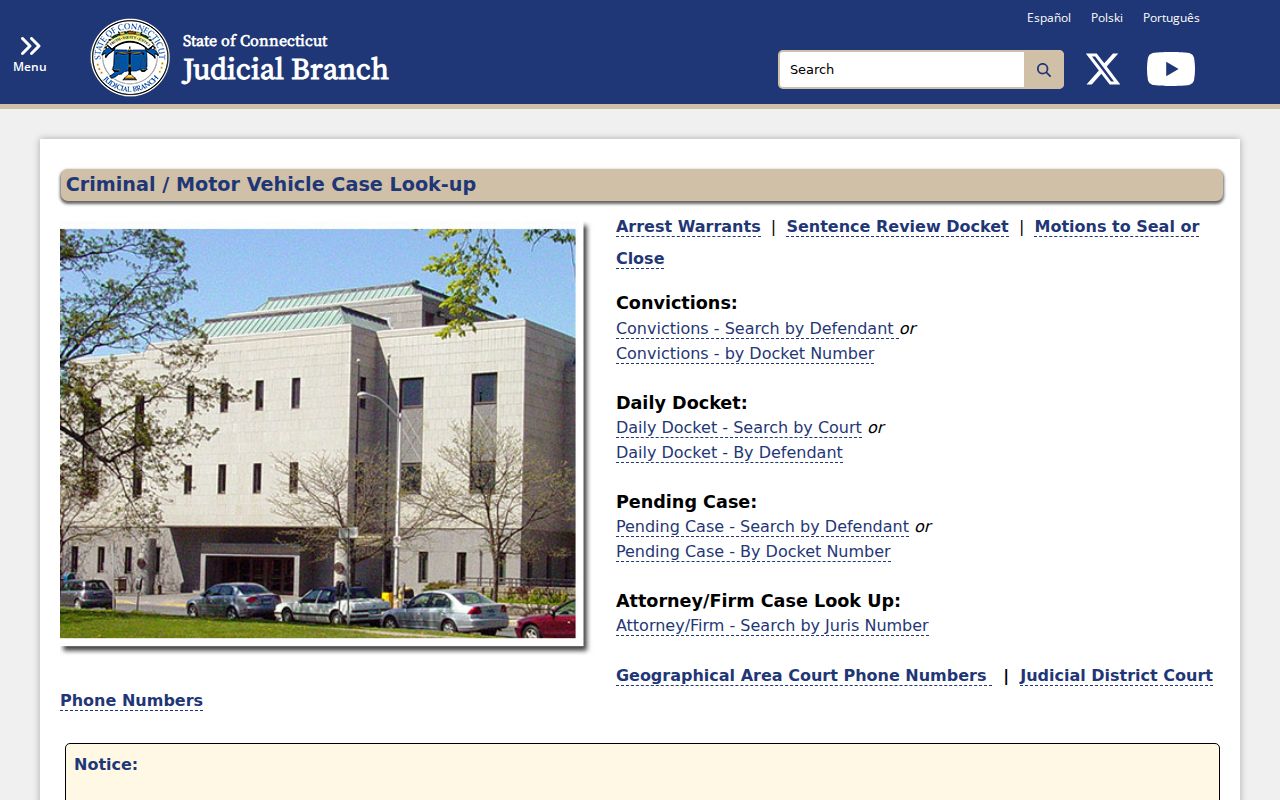
Its separate paths help readers avoid treating a pending charge as a conviction.
The official conviction search by defendant provides the name-based disposition layer.
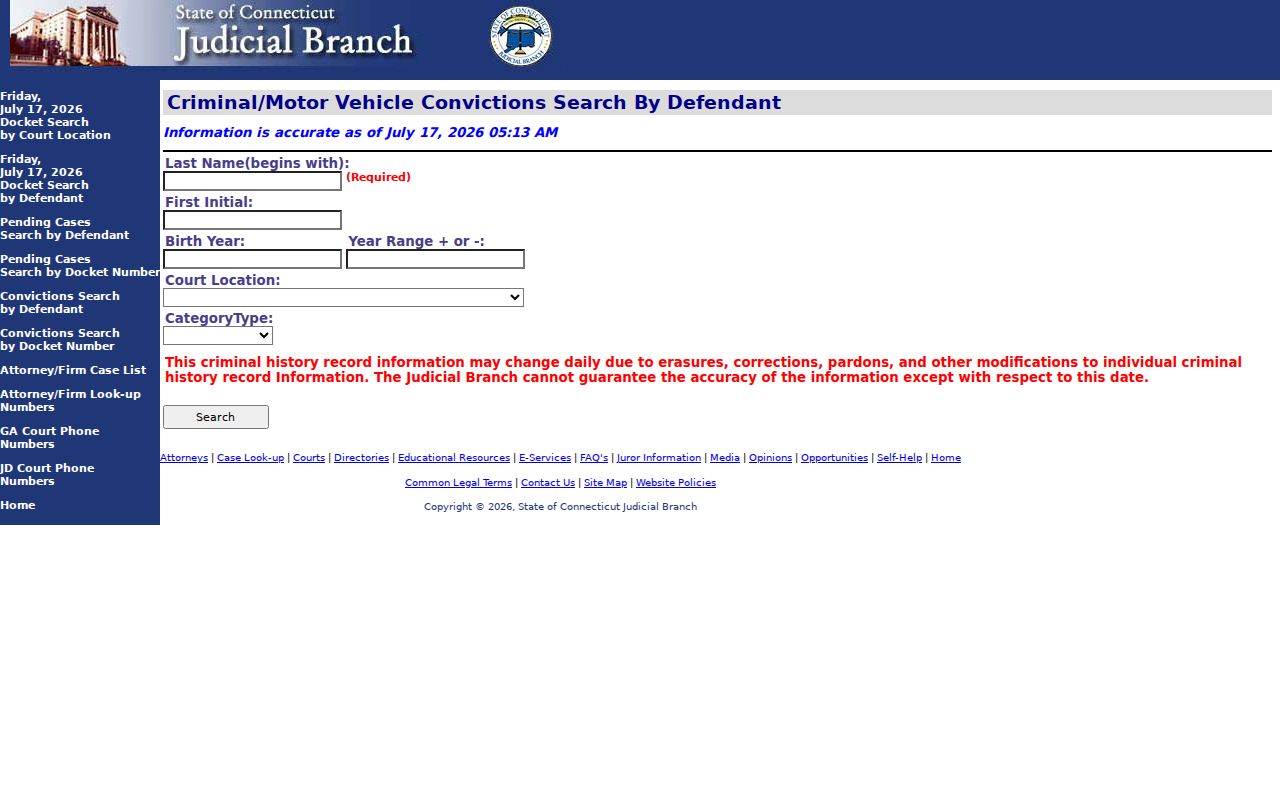
Verify the court location and date of birth before tying a result to a person.
The Judicial Branch also publishes criminal case help for common record tasks.
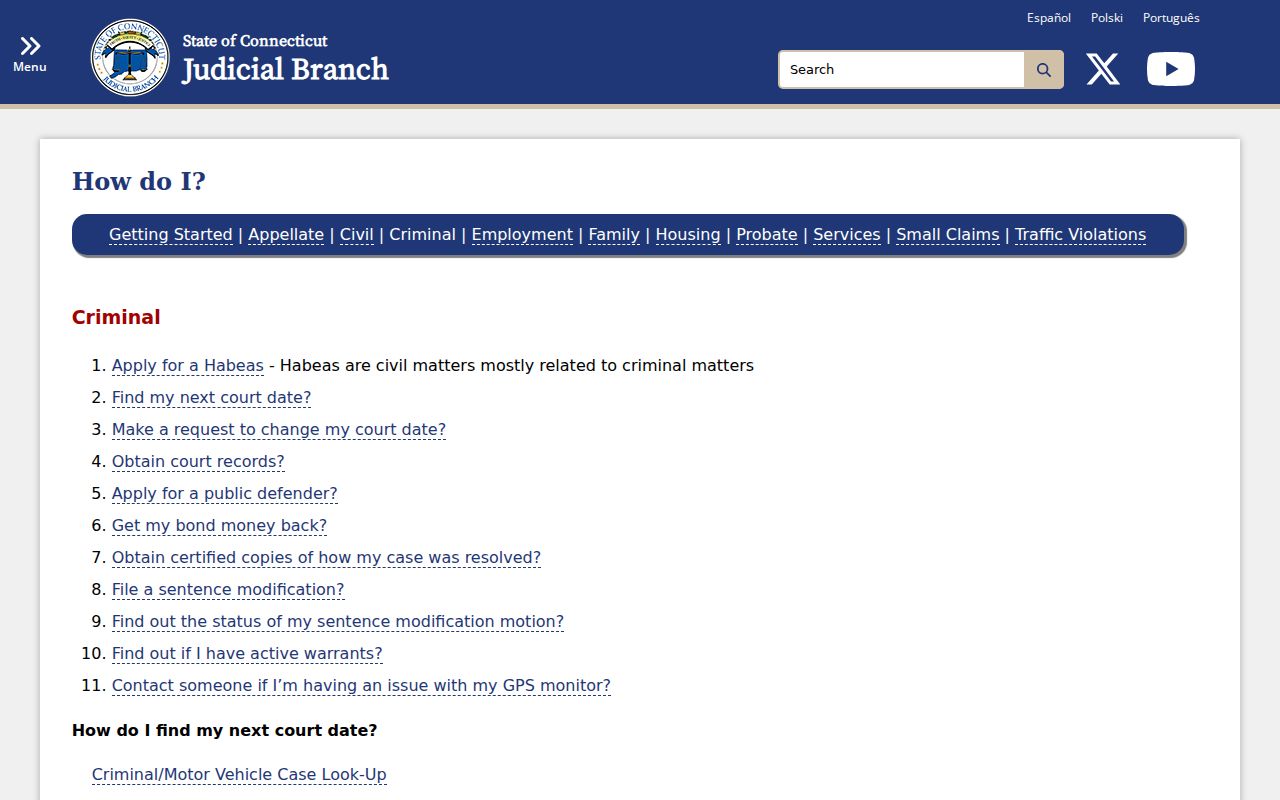
That help route is useful when the search screen alone does not answer how to obtain a document.
Researchers studying aggregate trends can use the Judicial Branch public data products.
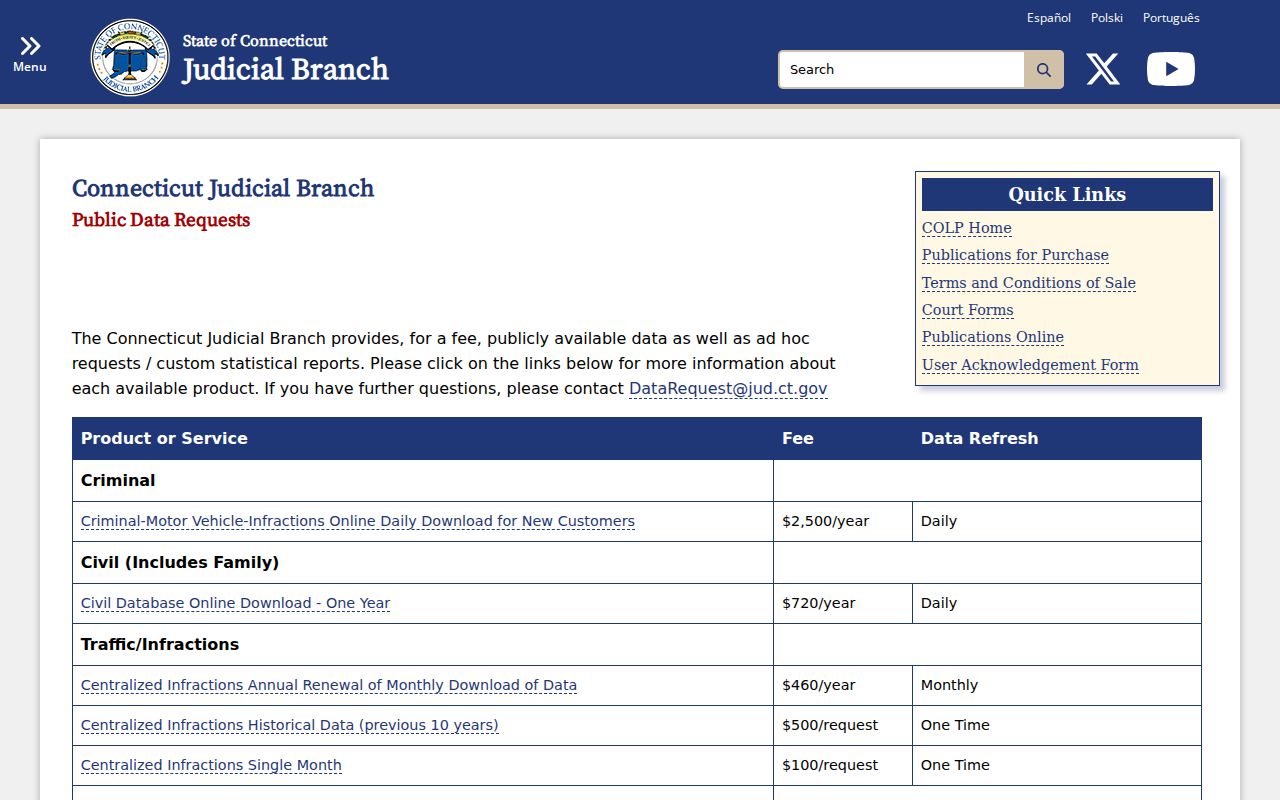
Aggregate data describes court activity, not the guilt or history of any individual.
Access & Restrictions
Connecticut generally provides public access to adult criminal court records, but access is not absolute. Erased cases, youthful-offender matters, juvenile files, sealed material, protected victim details, and records restricted by court order may be absent or redacted. Online access can also be narrower than the record available at the clerk's counter.
Under Connecticut's erasure framework, qualifying dismissals, acquittals, nolles after the statutory period, pardons, and Clean Slate relief can remove records from ordinary public access. Ask the clerk about the status of a known docket without demanding protected content. The Connecticut Clean Slate portal explains the state program, while the court remains the source for a particular case file.
Access rule: A public docket is a court record, not proof of identity and not a complete statewide criminal-history product. Confirm the person, court, charge, and final disposition.
Waterbury readers can also separate individual case research from aggregate court data. The Judicial Branch public-data products summarize system activity, while the docket lookup answers what occurred in a named case. The 2024 Waterbury Judicial District report supplies context on filings, warrants, arrests, and case flow across the eight-town district. Those totals do not establish any person's conduct. For a known matter, the UWY docket, filed charge, dated event entries, and final count-by-count disposition remain the controlling public trail. When those fields conflict with a police narrative, remember that prosecutors may amend the initial charges before arraignment, plea, trial, or dismissal. Request a certified disposition from the clerk when an official copy of the outcome is required.