
Running a Sex Offender Check in Waterbury
The primary channel is the Connecticut Sex Offender Registry. DESPP maintains it under Chapter 969. Search by a person's name when identity is known, or use town, ZIP, address, and mapping tools for Waterbury-area awareness. The portal begins with terms that must be accepted before search access.
Local police must make public registry information available during normal business hours under Conn. Gen. Stat. § 54-258. Waterbury Police is therefore the in-person or phone fallback, but it does not replace the statewide registry. Carry the correct spelling, address, town, or ZIP into the search and compare the profile photograph and descriptors before drawing a conclusion.
Waterbury Registry Means Notification
Connecticut's registry is an offense-based statutory publication system. It is not a score of a person's future risk, and a listing does not mean that a new offense has occurred. The useful question is whether the profile matches the person or address being researched and whether the status and verification information is current.
Victim identity and treatment information are not public registry fields. That exclusion protects people harmed by crime while still allowing publication of the registrant data authorized by law. Community awareness should focus on verified facts and practical safety plans, not rumor or assumptions about a neighborhood.
A registry entry is also narrower than a general criminal-history record. It publishes the information Chapter 969 authorizes for covered registration obligations. It does not replace the criminal court docket, an arrest report, or a statewide SPBI conviction-history product. Those sources answer different questions and may have different dates, language, and access rules.
Searching the Connecticut Sex Offender Registry
DESPP's search screen offers name and address modes, plus map or list presentation and an email-alert path. The live vendor interface blocked automated inspection during research. Official DESPP material independently confirms searches by last name, town, ZIP, complete list, mapping, and proximity alerts, but exact radius values and current button labels must be checked on the live screen.
- Open the official registry and accept its disclaimer and lawful-use warning.
- Choose a name search or use a Waterbury address, town, or ZIP search.
- Compare result photos, aliases, physical descriptors, and locations to avoid a false match.
- Open the full profile and read the offense, registration status, address, and verification details.
| Field Label | Type | Required | Notes |
|---|---|---|---|
| Last Name | Text | Name mode | Full or partial behavior requires live verification. |
| First Name | Text | No | Narrows a surname search. |
| Address | Text | Address mode | Street address for proximity searching. |
| City / ZIP | Text or selection | No | Use Waterbury or a five-digit ZIP to localize. |
| Radius / Map | Selection and map | No | Available, but exact current radius choices require live verification. |
Waterbury Name Search Versus Address Alerts
A name search answers whether a known person has a published Connecticut profile. An address search instead supports place-based awareness. Official Judicial Branch guidance says a person may enroll for email notice when a published registrant registers within one mile of a supplied address.
| Name Search | Address Alert |
|---|---|
| Starts with a known first or last name. | Starts with an address supplied for notification. |
| Useful for matching a specific profile. | Provides notice of a later registration within one mile. |
| Requires care with aliases and common names. | Does not replace checking the current map or profile. |
Note: An alert reports a registry event near an address; it is not a prediction of future conduct.
Use both tools when the goal combines a known identity with ongoing awareness around a Waterbury address. First confirm the individual profile through name search, then enroll the address if future proximity notices would be useful. An alert cannot establish that the person seen nearby is the listed registrant, and a name result cannot prove where that person is located today without checking the current address and status fields.
What a Registry Profile Shows
A Connecticut profile combines identity, location, offense, and compliance fields authorized for public notice. Fields can vary by statutory route and the information reported. Read the latest address and status alongside verification dates rather than relying on a photo or name alone.
| Name & Aliases | Published identity names used to match the correct person. |
|---|---|
| Photo & Physical Description | Photograph and descriptors, potentially including scars, marks, or tattoos. |
| Registered Address | Reported residential address and related change information. |
| Offense & Statute | Qualifying offense, statute, conviction, and court or jurisdiction information. |
| Duration Route | Registration start, end, or duration tied to the governing statutory route. |
| Registration Status | Compliance or noncompliance information and relevant verification details. |
Cross State Lines with NSOPW
Connecticut's portal is the best first stop for a Waterbury-focused check. When a search involves a recent move or another state, the U.S. Department of Justice's National Sex Offender Public Website adds a cross-jurisdiction layer. NSOPW searches participating public registries; the source state's profile remains the place to read the underlying entry.
The national portal's search view shows why location coverage matters when a person or address trail crosses a border.
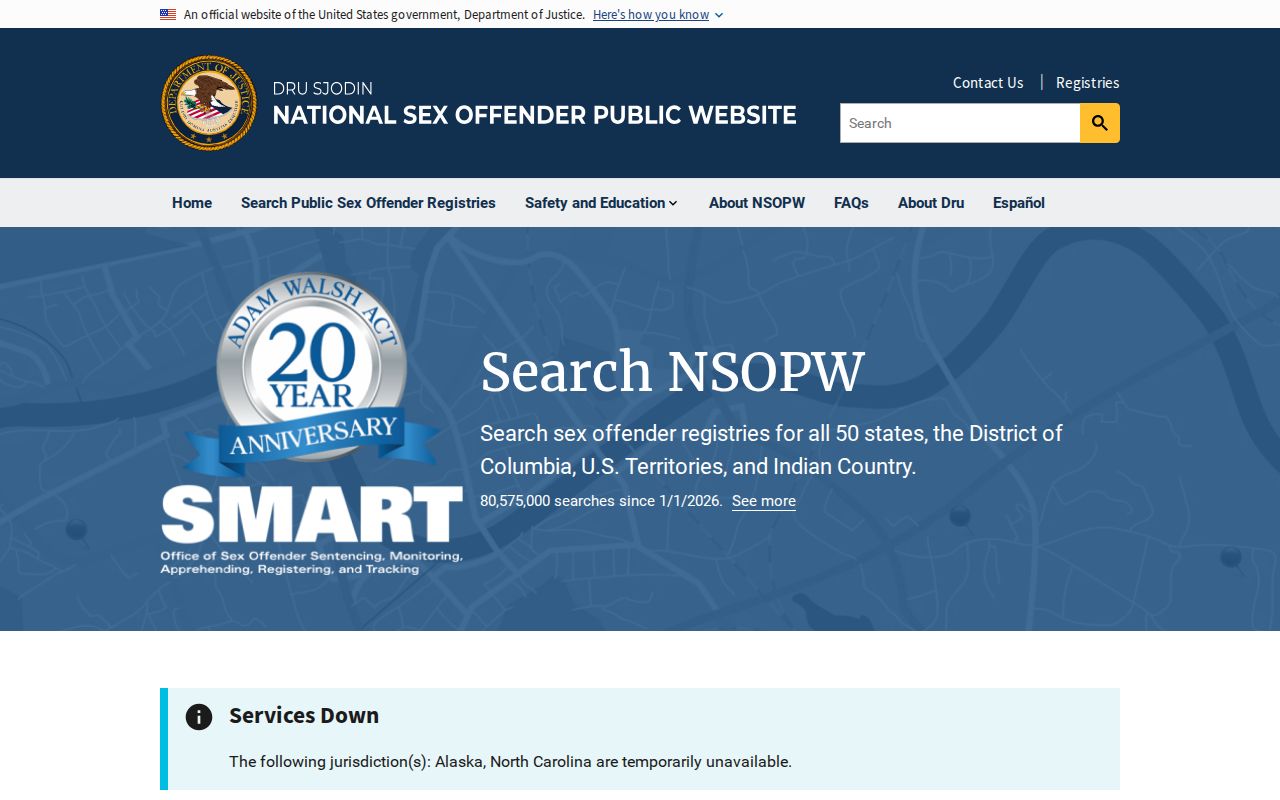
Return to the Connecticut record for state-specific registration terms, then contact the responsible agency if information appears inconsistent.
Cross-state searching is especially useful when the available facts include an out-of-state conviction, former address, school, or work location. Registration duties are administered by each jurisdiction, so a national result may route to a source profile with different field labels and public rules. Preserve the source state when taking notes and do not assume Connecticut's duration framework governs another state's entry.
Registration Requirements and Levels in Connecticut
Connecticut does not publish a simple Tier I, Tier II, and Tier III public risk-ranking table. Duration follows the covered offense or statutory registration route. Sections 54-251 and 54-252 commonly yield ten-year registration for specified covered offenses and lifetime registration for sexually violent offenses. Court-ordered and interstate routes require their own statutory reading.
| Connecticut Route | Duration | Public Rule |
|---|---|---|
| § 54-251 covered conviction | Generally 10 years | Check offense and date exceptions in current law. |
| § 54-252 sexually violent offense | Life | Quarterly address-verification framework applies. |
| § 54-253 court-ordered registration | Ordered or statutory period | The court finding controls. |
| § 54-254 covered nonresident, student, or worker | Underlying obligation | Interstate registration rules apply. |
The current Chapter 969 text is the source for these routes.
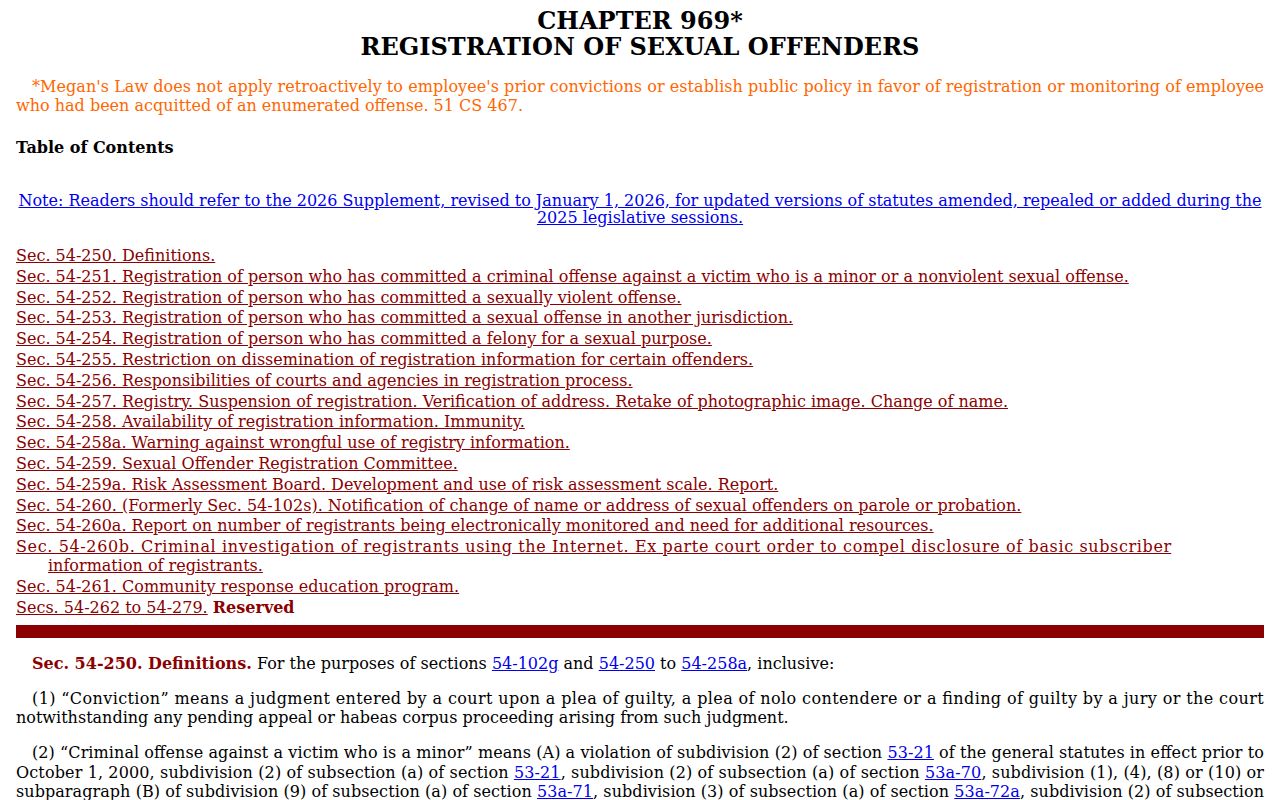
Use the current statute and the individual profile instead of importing a risk-tier label from another state.
Duration language needs care because the conviction date, offense, court finding, and interstate status can affect the controlling route. “Generally ten years” is not a promise that every § 54-251 obligation ends on the same schedule. A lifetime entry under § 54-252 is likewise a legal registration category, not a public agency's prediction of future behavior. When an end date or route is unclear, ask SORU for an administrative correction or explanation rather than assigning a tier.
Waterbury Address Verification Every Ninety Days
Section 54-257 sets the registry's maintenance, photograph, address-verification, and change-reporting framework. People registered under §§ 54-251, 54-252, and 54-253 receive address verification every ninety days. That recurring cycle helps explain why a profile carries status and compliance information rather than functioning as a static historical list.
If a Waterbury address appears outdated, do not investigate at the residence. Report the concern to WPD or DESPP. The central Sex Offender Registry Unit can be reached at SORU@ct.gov or 860-685-8060, with fax 860-772-1730. Its office is at 1111 Country Club Road, Middletown, and current in-person registration hours are Monday through Friday, 9 a.m. to 3 p.m., holidays excluded.
Verification and public correction are separate tasks. A registrant responds through the statutory reporting process, while a member of the public reports a suspected mismatch to officials. Give the agency the profile, address, and observed discrepancy without embellishment. Officials can compare nonpublic administrative data and determine whether the web entry needs an update or whether a compliance inquiry is warranted.
Waterbury Police Is the Local Fallback
Waterbury Police receives registration information and must make public registry information available during normal business hours. Call the main department number at 203-574-6920 or use the Records counter at 255 East Main Street when the online portal cannot answer an access question. Suspected noncompliance also belongs with WPD or DESPP, not with neighbors or social media.
The state portal remains the first choice because DESPP administers the registry across Connecticut. Local police can address Waterbury-specific access and reporting, while SORU handles central corrections. This division also matters when an address change is recent and a web profile seems out of sync.
For in-person public access, call before traveling and describe the specific registry information sought. Police Records staff also handle other municipal records, but an arrest narrative or incident report follows FOI rules separate from registry publication. Keeping the request limited to registry information helps route it correctly and avoids confusion with a criminal-history or warrant inquiry.
Lawful Use and Community Notification
Registry information is published for awareness and safety planning. Connecticut supports direct portal searches, map and list views, and one-mile email alerts. Verify the profile, use normal safety channels, and report a possible error or violation to the responsible agency. Do not publish accusations beyond what an official record states.
Misuse is unlawful: Connecticut's portal warns that registry information may not be used to threaten, intimidate, or harass. Section 54-259 provides criminal penalties for prohibited conduct; report concerns to WPD or DESPP instead of confronting anyone.