
How to Check Criminal History in Waterbury
Start with the office that created the record. Waterbury Police holds incident and arrest narratives. Connecticut courts hold filed charges and outcomes. SPBI provides statewide repository products, and Connecticut DOC reports current state custody. No result replaces the others.
- Identify whether the question concerns a police report, court case, custody record, or statewide history.
- Use Waterbury GovQA or WPD Records for an incident report.
- Search the Judicial Branch criminal lookup for the filed docket.
- Check Connecticut DOC if current custody matters.
- Order an SPBI name or fingerprint product for statewide history.
Waterbury Police Records at East Main
WPD Records is at 255 East Main Street, Waterbury, CT 06702. Call Records at 203-574-6933, the Front Desk at 203-574-6920, or dispatch at 203-574-6911. Research supports general Records access Monday through Friday, 9 a.m. to 4:30 p.m. Call first because narrower hours on a newer page appear beneath pistol-permit instructions.
WPD Records Division
255 East Main Street
Waterbury, CT 06702
203-574-6933
Incident reports, FOI requests, crash routing, and local checks
Provide the date, time, location, involved party, and report number. State whether the request includes supplements, photos, video, CAD, or lab records.
The Waterbury Police Department
WPD dates to 1853 and reports roughly 350 personnel. Its Records Division keeps incident and crash reports and processes requests under Connecticut's Freedom of Information Act. A report records allegations and officer activity known at the time. It cannot establish the final prosecution result.
GovQA offers request submission, a personal request center, a public archive, trending topics, and status tools. Archive users can search by keyword or request number, filter dates and status, sort columns, and page through results. The session-based request screen was not reliably inspectable, so no unseen required field or base fee should be assumed.
Waterbury GovQA Versus BuyCrash
WPD separates incident requests from crash requests. GovQA handles incident reports, arrest narratives, video, CAD, and other police public records. The WPD-prefiltered LexisNexis BuyCrash route handles motor-vehicle accident reports.
| Channel | Use it for | Supply |
|---|---|---|
| GovQA | Incident, arrest, FOI, video, supplements | Date, place, party, report number |
| BuyCrash | Crash reports | Crash date, location, party |
| Records phone | Portal trouble | Known event details |
No indexed official source gives a current standard copy fee. Request an estimate.
Arrests and Bookings in Waterbury
WPD documents the arrest and initial booking, but Waterbury has no public city roster, county jail list, sheriff app, or official daily arrest blotter. Request the releasable narrative from WPD. Search the court docket next. If the court remands the accused, DOC becomes the custody source.
Connecticut General Statutes §1-215 opens minimum arrest facts, including name and address, arrest date, time and place, and offense. More can be limited by active-investigation, victim, juvenile, privacy, and other lawful rules. Arrest is not conviction.
How Waterbury Arrests Enter State Custody
Connecticut unified local jails under the Department of Correction in 1968. WPD may hold a person during processing, but longer pretrial confinement after remand is a state function. DOC may label a person accused or sentenced. That distinction matters.
Custody flow: WPD Arrest › Court Presentment › Release or Bond Decision › DOC Remand if Ordered
A custody entry cannot show that each initial charge led to conviction.
Waterbury Municipal Court Records
Waterbury has no municipal criminal court. Superior Court G.A. 4 at 400 Grand Street hears local criminal and motor-vehicle matters. Waterbury Judicial District Part A handles the most serious felonies. Call the clerk at 203-236-8100 or Public Information Desk at 203-236-8270.
| Court | Connecticut Superior Court G.A. 4 and Waterbury Part A |
|---|---|
| Cases | Motor-vehicle, misdemeanor, and felony matters |
| Lookup | Judicial Branch search, clerk, or Public Information Desk |
| Docket | Charges, events, pleas, disposition, sentence |
| Copies | Ask the clerk for current terms and certification cost |
Waterbury Court and Federal Layers
The Waterbury State's Attorney identifies the local Part A and G.A. prosecution units.
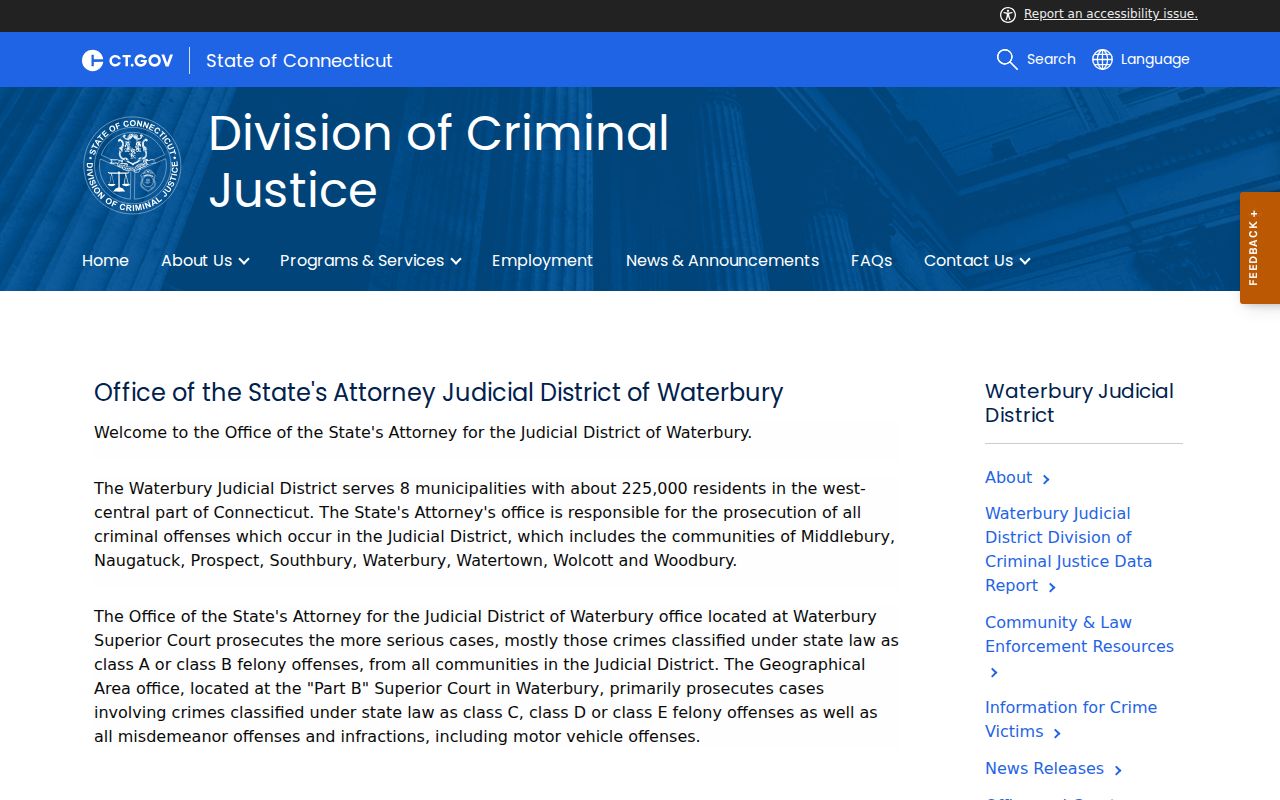
The clerk, not prosecutor, holds the public court file.
Federal cases require PACER.
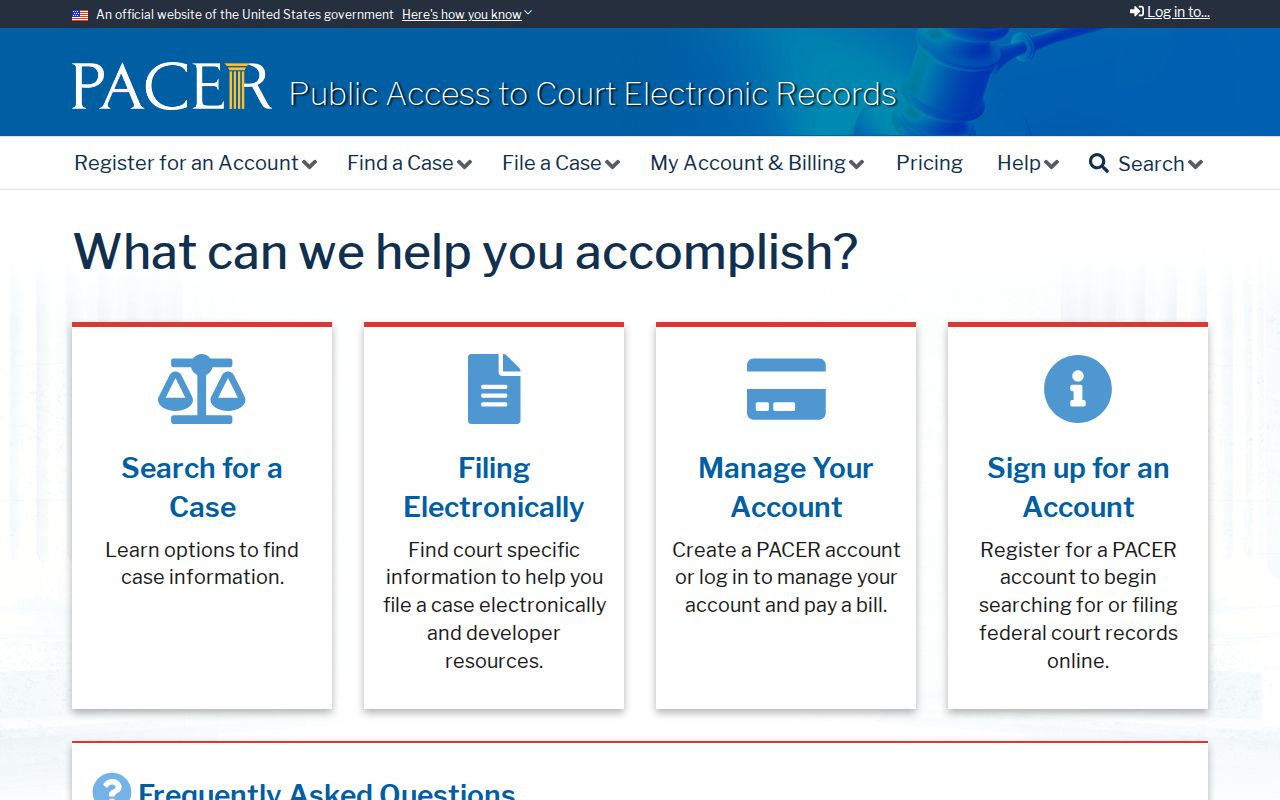
PACER does not replace state records.
Federal custody requires the BOP locator.
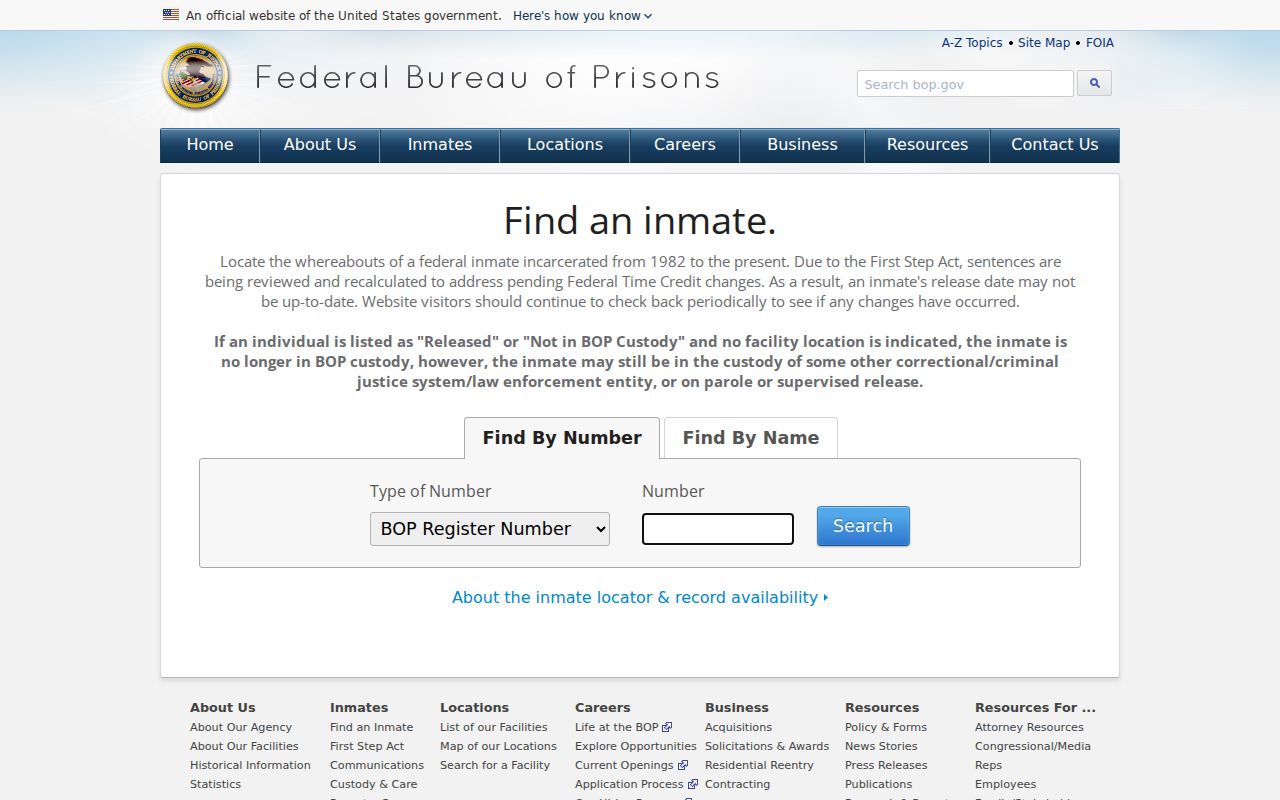
A federal locator result cannot explain a Connecticut docket.
Where Waterbury Records End Up
A WPD report stays with police after prosecutors file a case. The Judicial Branch creates a separate docket. Reportable outcomes flow to DESPP's State Police Bureau of Identification.
Record flow: Waterbury Police › Connecticut Superior Court › DESPP State Police Bureau of Identification
Recent activity calls for WPD and pending-case search. A completed matter calls for the disposition. A statewide identity product comes from SPBI, with IDEMIA used for fingerprint enrollment.
The Free Waterbury Local Check
WPD offers a free local criminal-history check with proper identification. It covers local city records, not every Connecticut department, federal court, or out-of-state repository. It is useful when reviewing one's own Waterbury record but is not the same as SPBI.
SPBI's products answer broader Connecticut questions. Research distinguishes a lower-cost name and date-of-birth search from a more detailed name-based record and a fingerprint-associated result. The products are not interchangeable, and the fingerprint route is strongest when identity certainty matters. Connecticut uses the CCHRS IDEMIA pre-enrollment channel for fingerprint capture. Follow the current SPBI directions rather than relying on a city counter for a statewide record.
A police incident report can survive even when court charges change. A dismissed or erased court case may disappear from ordinary judicial search while access to the underlying police material is governed by separate law. The reader should compare the WPD incident number with the UWY docket number and the SPBI response. Those identifiers show whether records describe the same event.
Compare names, birth dates, event dates, incident numbers, and docket numbers. Direct a correction request to the office that created the disputed entry. WPD corrects its report data, the clerk addresses the court docket, DOC addresses custody fields, and SPBI handles the repository product.
Waterbury District Crime Context
Official 2024 data says Waterbury accounted for 93% of reported violent crime and 81% of property crime in the eight-town judicial district, while WPD made 71% of district arrests. The denominator is the district, not city population. These figures do not prove guilt.
The FBI Crime Data Explorer adds official aggregate context.

Statistics cannot identify an individual's history or predict risk.
Waterbury Forensic Supplements
WPD's Real Time Crime Center has operated since 2021. Its annual report discusses NexGen, body-camera evidence, NIBIN, and rapid DNA. In fiscal 2022-23, 521 cartridge cases produced 1,254 NIBIN investigative leads. A lead is an investigative association, not proof.
Waterbury is one of seven Connecticut NIBIN kiosk locations identified by DESPP. The kiosk lets shell-casing images enter the National Integrated Ballistic Information Network promptly. City budget materials also describe a forensic-lab expansion with a dedicated NIBIN and Rapid DNA room. These tools can generate investigative associations and later supplements, but neither a ballistic lead nor a laboratory submission establishes guilt.
The first incident report may exclude later lab reports, photos, video, CAD entries, or supplements. Name each desired category in GovQA. A focused request can ask separately for the narrative, photographs, body-camera footage, dispatch audio, CAD logs, forensic reports, and laboratory attachments. Active material may be withheld under a lawful exemption, and large electronic files may require different delivery arrangements from a short report.
Waterbury's Downtown Records Corridor
Waterbury's justice offices form an unusually compact downtown corridor. Police headquarters stands on East Main Street, criminal court is at 400 Grand Street, the Judicial District courthouse is at 300 Grand, probation is on Scovill Street, and the Board of Pardons and Paroles is at 55 West Main Street. That layout helps a reader move a known incident from the police custodian to the correct state office without imagining a county records department that does not exist.
The buildings also preserve the Brass City's institutional history. WPD began on July 28, 1853 with 25 men. Its current headquarters occupies the former Waterbury High School and Crosby High School site. The earlier school opened in 1896, while the police facility dates to 1978. Nearby, the present City Hall was designed by Cass Gilbert and dedicated in 1915 after an earlier city hall burned. These facts explain why several distinct record custodians sit close together but do not share one database.
For a court visit, official guidance identifies a municipal lot on Field Street between Meadow and Grand and limited free public court parking in the adjacent State Street ramp. Parking availability can change, so confirm current court guidance before traveling. Physical proximity does not merge access rules. WPD answers police-record requests, the clerk answers docket questions, probation keeps supervision material, and the Board of Pardons and Paroles handles its statewide functions.
Public Access Rules
Connecticut FOIA governs WPD requests, while Judicial Branch rules govern court access. Juvenile, youthful-offender, erased, victim, medical, sealed, and active-investigation material may be absent or redacted.
The channel matters when a result is missing. GovQA can retrieve releasable police material. The clerk can check a known docket not indexed online. DOC answers current custody questions, and SPBI supplies repository products. Precise dates, places, names, and identifiers reduce delay and help a custodian review specific portions.
Connecticut erasure is more precise than generic expungement. Qualifying dismissals, acquittals, nolles after the statutory period, pardons, and Clean Slate relief can restrict public access. Systems may not change at the same moment, so a person reviewing their own history should compare the court disposition and repository response.
Key Statutes:
Connecticut Freedom of Information Act opens agency records subject to exemptions.
§1-215 opens minimum arrest information.
§54-142a governs erasure.
Do not infer guilt from an arrest, pending case, custody entry, or redaction.
Waterbury's local record geography also reflects the city's place in the eight-town judicial district. The G.A. 4 service area reaches beyond city lines, so a Judicial Branch result must be checked for the court location and the agency tied to the event. WPD accounted for 71 percent of district arrests in the official 2024 report, but other municipal agencies also send cases to Waterbury court. A docket at 400 Grand therefore does not prove that Waterbury Police made the arrest. The arresting-agency field, police incident number, and court docket should be read together.
Serious case support is concentrated downtown. The State's Attorney at 400 Grand prosecutes the district's Part A and G.A. matters. The Waterbury Judicial District Public Defender uses the same address, and a Community Court Public Defender is also listed there. The Parole Revocation Unit is at 55 West Main Street. These offices serve different roles and do not release one combined criminal-history report. The Public Defender warns about impostor bail-payment calls: genuine defenders do not telephone demanding immediate cash or credit-card payment. Court dates and bond information should be verified with the official clerk rather than a caller.
City history adds useful context to the record system without changing the access rules. Waterbury grew around brass firms such as Benedict and Burnham and Scovill, earning the Brass City name. Its dense center and hillside neighborhoods developed around former mill corridors. Territorial changes involving Watertown, Plymouth, Wolcott, Middlebury, Prospect, and Naugatuck helped shape the surrounding region now served through state judicial structures. Connecticut counties no longer operate local justice government, so those shared regional ties do not create a county-level sheriff, jail, or clerk for Waterbury. The correct route remains city police for WPD reports and state agencies for courts, custody, repository history, probation, parole, and pardons.
Population figures should be dated as carefully as crime figures. Census QuickFacts estimates 115,908 Waterbury residents on July 1, 2024, compared with 114,403 at the 2020 Census and 110,366 in 2010. Those counts provide civic scale, not a denominator for judging a particular record. The district crime percentages use an eight-town justice area, while Census figures describe the city. Mixing the two would produce a false conclusion. Official statistics are best used to understand agency workload and system scope, never to infer that a resident, address, or neighborhood has a criminal history.